Quick Answer
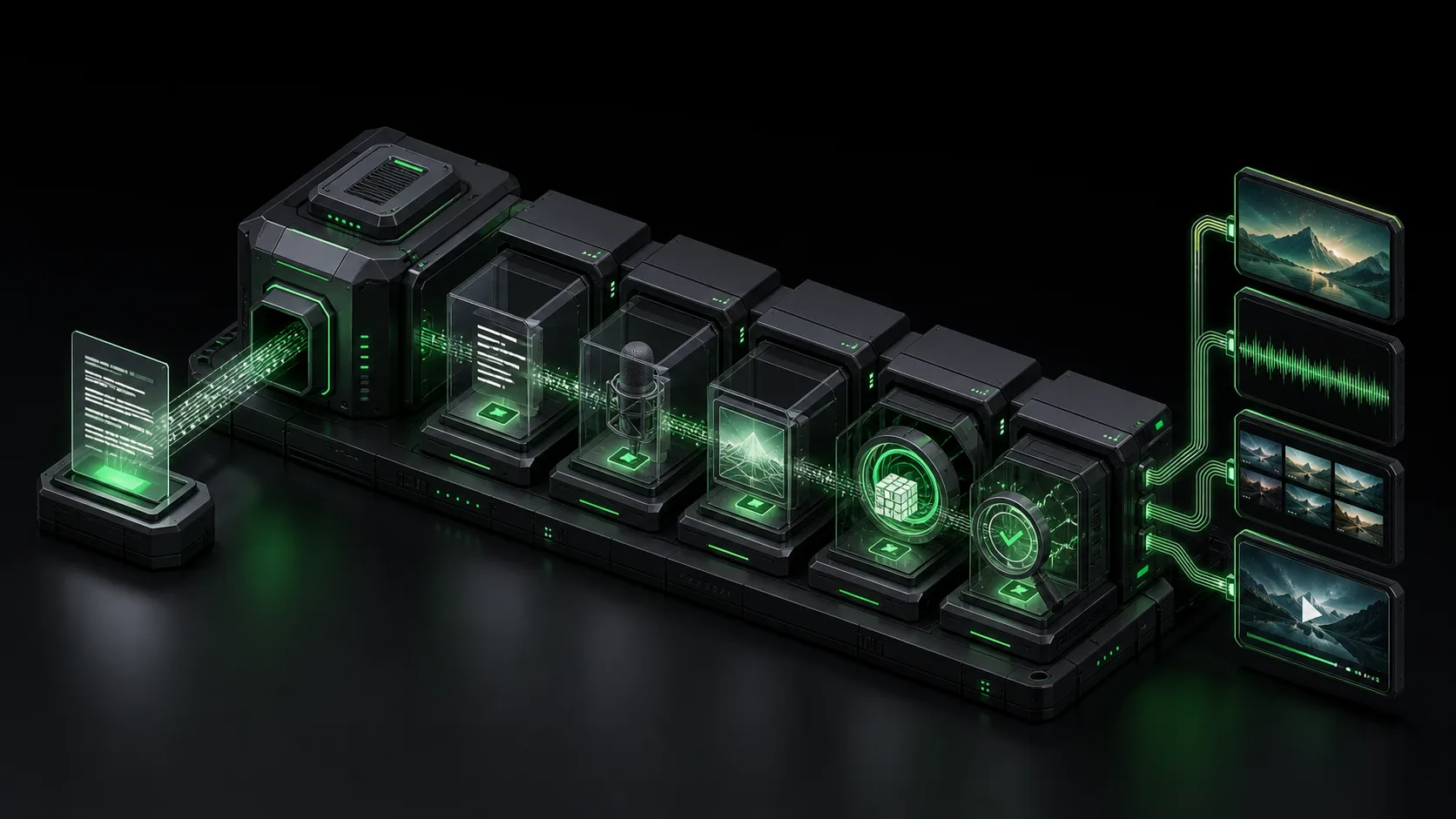
OpenMontage is interesting because it treats video production like a pipeline, not a prompt box. The repo describes an agentic system that can take source material, transcribe it, plan the script, generate voice, assemble visuals, render the final piece, and run checks before the operator touches distribution. That matters for content teams because the bottleneck is rarely one missing AI tool. The bottleneck is the stitching: copy text here, export audio there, rebuild captions somewhere else, then hope the final file still matches the idea. OpenMontage points at a different operating model: one repo, one brief, one repeatable production path. The promise is not magic. The promise is fewer handoffs.
Most people do not have a video problem. They have a moving-parts problem.
One short clip can require a downloader, a transcription tool, a script pass, a voice tool, an animation layer, a visual editor, a caption pass, a render step, and a final QA check. That sounds normal until you try to do it every day. Then the hidden cost appears: every handoff introduces another place where the idea gets diluted.
OpenMontage, the GitHub repo from calesthio/OpenMontage, is built around the opposite assumption. The repo describes itself as an open-source, agentic video production system with 12 pipelines, 52 tools, and 500+ agent skills. A live GitHub check on July 2, 2026 showed 31K+ stars and 3.5K+ forks. That does not prove it is right for every team, but it does prove the idea has attention from builders.
Definition
Agentic video production means an AI coding assistant coordinates the production workflow across tools, files, prompts, assets, and render steps. The operator gives the direction. The agent handles the sequence.
The Real Problem Is Stitching
The usual AI video stack looks productive from the outside. Inside the workflow, it is fragile. A team starts with a prompt, gets a transcript, rewrites the hook, moves to another app for voice, exports a file, adds captions, cuts clips, then manually checks whether the output still supports the original angle.
That is not a system. It is a chain of chores.
OpenMontage is compelling because it makes the workflow explicit. The source brief for this video frames the system as a connected path: download, transcription, research, script generation, voice, animation, visualization, enrichment, and QA. The value is not that every step is new. The value is that the steps have a home.
What OpenMontage Changes
A prompt box gives you one output. A pipeline gives you a process you can inspect, repeat, and improve.
| Production choice | Typical tool stack | OpenMontage-style workflow |
|---|---|---|
| Starting point | Prompt in one app | Brief or source material routed into a pipeline |
| Script | Manual rewrite or separate AI chat | Agent-managed script stage |
| Voice and visuals | Separate exports | Connected stages with shared context |
| QA | Human memory | Pipeline checks and artifacts |
| Repeatability | Depends on operator discipline | Depends on saved stages and files |
The key shift is operational. If a clip works, you should be able to see why. If it fails, you should be able to inspect the stage that failed. If a hook wins, you should be able to reuse the pattern without rebuilding the entire process from memory.
Why Builders Care
The OpenMontage pitch lands because content operators are hitting the same wall: AI tools made creation faster, but they also multiplied the number of tiny decisions needed to ship. That is fine for one experiment. It breaks when you need a reliable content engine.
A video factory needs three things:
Key Takeaways
- A single brief that survives the whole production path.
- A repeatable sequence of stages, not a pile of disconnected apps.
- A way to inspect outputs before they become public.
- A resource path that turns attention into a next step, not just views.
OpenMontage is not the only possible answer. But it is a useful signal: the market is moving from isolated generation toward production systems. The winning workflow is less about one impressive clip and more about whether the team can produce, check, and reuse the process without burning the operator every time.
The Business Angle
For a solo founder, agency, or content team, the question is not "Can this make a video?" The better question is "Can this reduce the number of handoffs between idea and publishable asset?"
That is where OpenMontage is worth studying. It treats the AI assistant as the coordinator. The repo becomes the production floor. The outputs become artifacts instead of one-off files.
The short video says it plainly: most people juggle five tools just to push one video out. OpenMontage tries to put that workflow behind one prompt.
That is the problem worth solving.
Frequently Asked Questions
Not exactly. It can reduce repetitive production work, but judgment still matters: hook selection, source quality, brand fit, and final approval still need an operator.